Introduction
On September 8th, 2025, Lighter tasked zkSecurity with auditing its Plonky2 circuits. The audit lasted three weeks with two consultants. During the engagement, the team was granted access to the relevant parts of the Lighter codebase via a custom repository. Additionally, a whitepaper and online documentation was shared, outlining various aspects of the protocol.
Scope
The primary scope of this audit was Lighter’s Block, Delta, and Wrapper layers. More specifically, it served as a follow-up to an engagement conducted just one month earlier. The previous audit focused extensively on Lighter’s top-level circuits in the Prover’s circuit/src/ directory, as well as all files in circuit/src/types/ and circuit/src/transactions/. The low-level circuit at circuit/src/bigint/unsafe_bit/mod.rs was also reviewed.
This audit, in contrast, concentrated on changes introduced by the Lighter team since that engagement. Specifically, the scope includes:
- The changes between commit
4876a50 and b119f03, which primarily is the account delta tree feature.
src/delta folder.src/recursion folder.src/bigint folder.src/hints folder.src/comparison folder.
Overview
The reports from our two previous audit engagements already provide extensive explanations of Lighter’s protocol. To avoid redundancy, we will not repeat those details here. Instead, we refer the reader to the first and second (to be published) report, as well as the whitepaper and documentation, for an introduction to the protocol.
Accordingly, this report does not include a general overview. Rather, we briefly highlight the circuit layers that were the focus of this particular audit and summarize the changes made to them.
Transaction Layer
- Changes to public data handling and tree structure: account tree moved under validium; metadata tree removed.
- Introduction of an account public data tree that aggregates deltas since genesis.
- Introduction of a per-batch delta tree that resets to an empty tree at the start of each batch.
Recursion Layer
- A cyclic aggregator that linearly accumulates proofs, verifying itself and a given group of block proofs.
- Produces a “segment” as output, with 1–8 segments expected per batch, to be consumed by the wrapper layer.
Delta Layer
- Rebuilds the delta tree of a given batch from scratch by inserting all non-empty delta leaves, in order.
- Verifies that the reconstructed delta root matches the root published at the transaction layer, ensuring the same data was issued on different layers.
- Evaluates a polynomial from the fields of delta leaves, on a pseudo-random point.
Wrapper Layer
- Verifies the segment proofs to connect them, and extracts the generated batch data.
- Consumes the blob array (i.e., the compressed, byte-serialized delta leaves), decompresses it, and performs polynomial evaluation on them at the same point, ensuring the blob data really corresponds to fields of the delta tree.
- Proves commitment equivalence on blob data to show the constructed blob data is the same as the one published on Ethereum.
Note: At the time of the engagement, updates to the wrapper layer were still in progress. Consequently, its review has been deferred to a future audit once those changes are complete.
Account Delta Tree
The account delta Merkle tree records the state changes for all accounts within a batch. It shares the same depth as the main account tree, with each leaf representing the delta for the account at that index. If an account’s state (such as its position) is updated during the batch, the corresponding leaf is populated with an AccountDeltaFullLeaf; otherwise, the leaf remains empty.
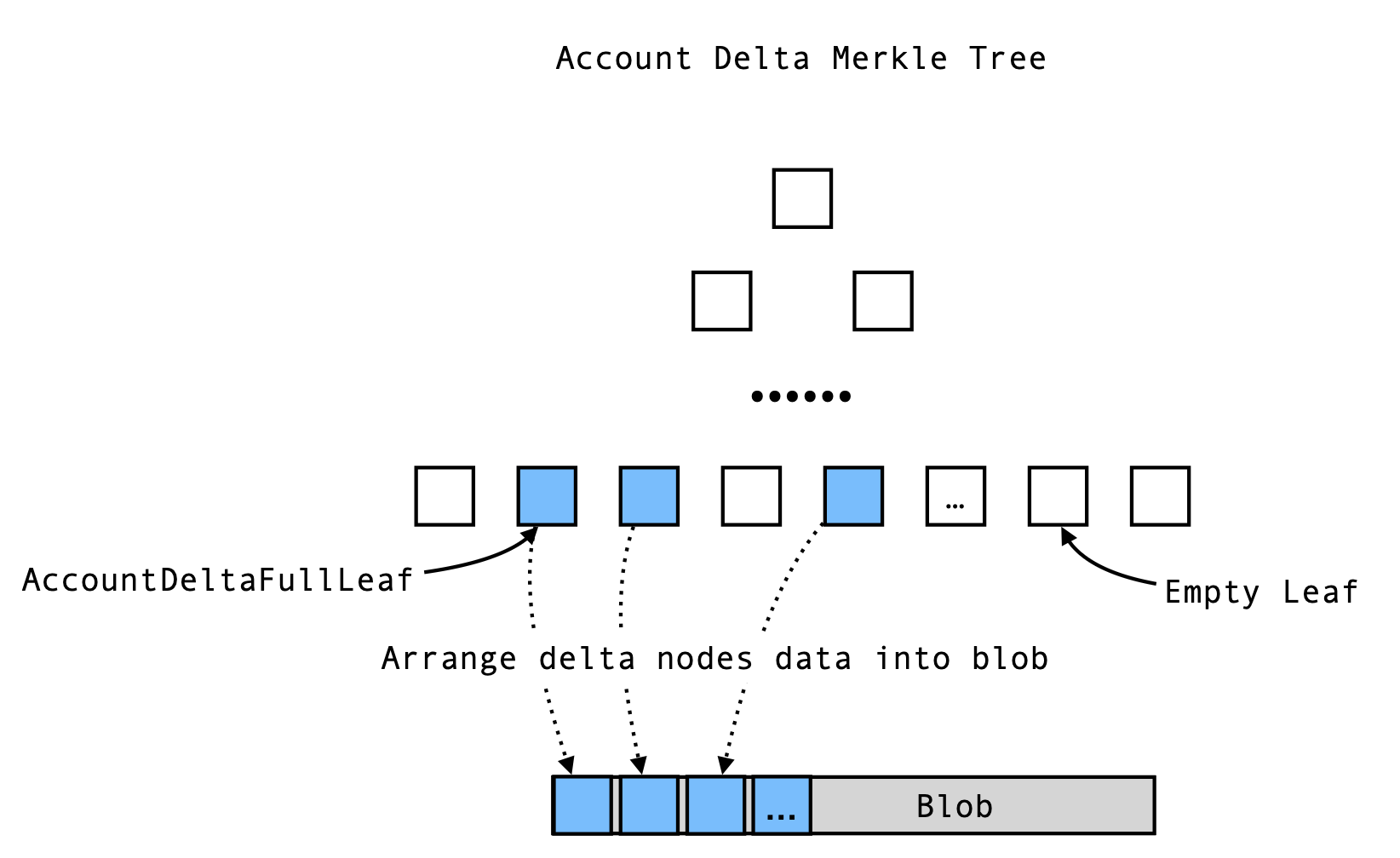
All non-empty leaves are collected and serialized into blob data for further comparison and verification.
Within the delta constraints, the circuit performs the following steps:
- Computes the Merkle root by processing non-empty leaves from left to right.
- Serializes the non-empty leaves into a blob array.
- Evaluates the blob as a polynomial at a pseudo-random point , treating each byte as a coefficient: .
Finally, the blob circuit need to witness Ethereum’s published blob data, performs the same polynomial evaluation, and checks that the results match. This ensures that all account deltas are correctly published and linked between layers.
Below are listed the findings found during the engagement. High severity findings can be seen as
so-called
"priority 0" issues that need fixing (potentially urgently). Medium severity findings are most often
serious
findings that have less impact (or are harder to exploit) than high-severity findings. Low severity
findings
are most often exploitable in contrived scenarios, if at all, but still warrant reflection. Findings
marked
as informational are general comments that did not fit any of the other criteria.
Description. The div_rem function currently asserts that the remainder is less than or equal to the divisor. However, according to the mathematical definition, the remainder of a division operation should always be strictly less than the divisor when the divisor is nonzero. When the divisor divides the dividend evenly, the current implementation allows the remainder to be equal to the divisor, which is incorrect. This can be exploited by a malicious prover to provide an invalid result for the function, potentially bypassing intended constraints.
The issue affects both the div_rem and conditional_div_rem in src/hint as well as the corresponding logic in bigint/div_rem.rs.
fn div_rem(
    &mut self,
    dividend: Target,
    divisor: Target,
    divisor_bits: usize,
) -> (Target, Target) {
    let quotient = self.add_virtual_target();
    let remainder = self.add_virtual_target();
    self.add_simple_generator(DivRemHintGenerator {
        dividend,
        divisor,
        quotient,
        remainder,
        _phantom: PhantomData,
    });

    // ...existing code...

    self.assert_lte(remainder, divisor, divisor_bits);

    (quotient, remainder)
}
Impact. A malicious prover can construct a proof where the remainder equals the divisor when the divisor divides the dividend exactly, violating the mathematical definition of division with remainder. This could result in incorrect computations being accepted by the system, potentially undermining the integrity of the protocol.
Recommendation. Update the implementation to ensure that, when the divisor is nonzero, the remainder is strictly less than the divisor (i.e., remainder < divisor). When the divisor is zero, the remainder can be set to zero or handled as a special case, depending on the intended semantics.
Client Response. Fixed in https://github.com/elliottech/lighter-prover/commit/b99c425b8c0868501e65e78fd16aaf16bbe0ea2b, https://github.com/elliottech/lighter-prover/commit/6c75178492c6c936706d0c61d7e80b5539f43e24 and https://github.com/elliottech/lighter-prover/commit/7f9fdc9439d47a0cb1beef6e2879e8a47b5a77e8.
Description. It is possible to generate the same PositionDeltaTarget::hash from different pairs of funding_rate_prefix_sum_delta and position_delta, in multiple ways.
We will denote PositionDeltaTarget::hash(funding_rate_prefix_sum_delta, position_delta) by hash(a, b) for simplicity. Here each of a and b have one limb indicating the sign, and 4 limbs indicating its absolute value. Note that a and b are the outputs from builder.bigint_u16_vector_diff, where sign lies in and each limb of abs lies in .
Bug 1: The zero hash will be returned when a.abs == b.abs == 0, and all of the below scenarios yield zero hashes
hash(a={abs: [0, 0, 0, 0], sign: 0}, b={abs: [0, 0, 0, 0], sign: 0}),hash(a={abs: [0, 0, 0, 0], sign: 0}, b={abs: [0, 0, 0, 0], sign: 2}) andhash(a={abs: [0, 0, 0, 0], sign: 0}, b={abs: [0, 0, 0, 0], sign: 1337}).
While the second is able to change the sign of position_delta from negative to positive, the third case would set position_delta to not fit a BigIntU16Target (as ).
Bug 2: The absolute values are passed to biguint_u16_to_target before they are hashed. All of the below scenario yield the same value in biguint_u16_to_target:
a={abs: [0, 1, 0, 0], sign: 1}a={abs: [65536, 0, 0, 0], sign: 1}a={abs: [14525421432217464134, 2509483414525841835, 13816656801863297087, 2586678164753412140], sign: 1}
Thus would result in the same hash if b is unchanged.
Impact. PositionDeltaTarget::hash would return the same digest in the above scenarios. Note that it is possible since neither funding_rate_prefix_sum_delta nor position_delta are range-checked.
This function is used by AccountDeltaFullLeafTarget::get_position_delta_root, thus it is possible to craft nodes to yield the same position_delta_root. It is possible to commit legitimate values and later reveal incorrect values that sign or abs do not lie to their respective ranges.
Recommendation. It is suggested not to use BigIntU16Target as the output of bigint_u16_vector_diff, since the condition and is not applied. The function could return and .
Only return the zero hash when both funding_rate_prefix_sum_delta.sign == 0 and position_delta.sign == 0. Additionally, avoid using biguint_u16_to_target to compute the hash; instead, use the limbs from abs directly.
Client Response. Fixed in https://github.com/elliottech/lighter-prover/commit/b99c425b8c0868501e65e78fd16aaf16bbe0ea2b.
Description. The bigint_to_signed_target_safe function is intended to convert a BigIntTarget value into a SignedTarget type. A BigIntTarget can represent large signed numbers using multiple limbs, while a SignedTarget is expected to be in the range , with negative values stored in the upper half of the field. However, the function does not enforce that the input is within the valid range for a SignedTarget, and can produce invalid results if the input is out of bounds.
The function first converts the absolute value of the input to a Target, ensuring it is within the field range, and then selects the result based on the sign:
fn bigint_to_signed_target_safe(&mut self, target: &BigIntTarget) -> SignedTarget {
    let positive_result = self.biguint_to_target_safe(&target.abs);
    let negative_result = self.neg(positive_result);
    let is_sign_negative = self.is_sign_negative(target.sign);

    SignedTarget::new_unsafe(self.select(is_sign_negative, negative_result, positive_result))
}
There are two main issues with this implementation:
- If the absolute value of the input exceeds , the output will also be outside the valid
SignedTarget range (greater than or less than ), resulting in an invalid value by definition.
- If the input is negative and its absolute value is greater than (where is the field modulus), the function will return the negative of the absolute value, which may not correspond to the intended representation. For example, if the input is (
sign = -1, abs = p-1), the output will be instead of , which is incorrect.
These issues can lead to subtle bugs or incorrect computations in circuits or protocols relying on this conversion.
Impact. The bigint_to_signed_target_safe function may produce invalid or unexpected results when the input is outside the valid SignedTarget range. This can silently compromise the correctness of the circuit.
Recommendation. Add an explicit range check to ensure that the absolute value of the input is strictly less than before performing the conversion.
Client Response. Fixed in https://github.com/elliottech/lighter-prover/commit/b99c425b8c0868501e65e78fd16aaf16bbe0ea2b.
Description. The functions sub_biguint and sub_biguint_u16 perform multi-limb subtraction and accumulate a borrow across limbs. However, after the loop, the final borrow is not checked or asserted to be zero. This means that if the first operand is less than the second (a < b), the subtraction will underflow, but the function will still return a result without indicating the error. The code comment suggests that “Borrow should be zero here,” but no assertion enforces this.
Example from sub_biguint_u16:
fn sub_biguint_u16(&mut self, a: &BigUintU16Target, b: &BigUintU16Target) -> BigUintU16Target {
    let (a, b) = self.pad_biguints_u16(a, b);
    let num_limbs = a.limbs.len();

    let mut result_limbs = vec![];

    let mut borrow = self.zero_u16();
    for i in 0..num_limbs {
        let (result, new_borrow) = self.sub_u16(a.limbs[i], b.limbs[i], borrow);
        result_limbs.push(result);
        borrow = new_borrow;
    }
    // Borrow should be zero here.

    BigUintU16Target {
        limbs: result_limbs,
    }
}
Impact. If a < b, the subtraction will underflow, and the returned result will be incorrect. This can lead to silent errors in circuits or protocols relying on these functions, as the borrow is not checked and no error is raised.
Recommendation. It is recommended to explicitly assert that the final borrow is zero after the subtraction loop to ensure that the result is only valid when a >= b.
Client Response. Fixed in https://github.com/elliottech/lighter-prover/commit/b99c425b8c0868501e65e78fd16aaf16bbe0ea2b.
Description. The function conditional_assert_zero_bigint enforces that when is_enabled is true, the absolute value is zero (a.abs == 0) but the sign equals 1. This contradicts the documentation and convention in the rest of the code, where:
sign = 1 → positivesign = -1 → negativesign = 0 → zero
Thus, the current assertion encodes a representation of zero (abs = 0, sign = 1) that is not consistent with the convention used in the other parts of the codebase.
Impact. Currently, the function is unused, so there is no immediate security impact. However, if later adopted, it would introduce inconsistency in zero representation.
Recommendation. Modify conditional_assert_zero_bigint as follows:
fn conditional_assert_zero_bigint(&mut self, is_enabled: BoolTarget, a: &BigIntTarget) {
    self.conditional_assert_zero_biguint(is_enabled, &a.abs);

-   let one = self.one();
-   self.conditional_assert_eq(is_enabled, a.sign.target, one);
+   self.conditional_assert_zero(is_enabled, a.sign.target);
}
Client Response. Fixed in https://github.com/elliottech/lighter-prover/commit/b99c425b8c0868501e65e78fd16aaf16bbe0ea2b.
Description. The functions sub_bigint_non_carry and sub_bigint_u16_non_carry both compute two candidate values: the absolute difference abs_diff = |a| − |b| and the absolute sum abs_sum = |a| + |b|. The correct result is selected based on the signs of the inputs (same sign → use abs_diff, opposite sign → use abs_sum). However, both branches are computed unconditionally, and the computation of abs_sum invokes add_biguint_non_carry(a.abs, b.abs, num_limbs), which asserts that the sum fits within num_limbs limbs by requiring the final carry to be zero:
self.assert_zero_u32(carry);
This means the “no overflow” constraint is enforced even when the sum branch is not selected. If |a| + |b| would overflow num_limbs (carry ≠ 0), but the selected difference |a| − |b| fits, the circuit still fails due to the unused sum branch’s assertion. The same issue is inherited by add_bigint_non_carry, which is implemented via sub_bigint_non_carry.
In summary, constraints from the unused branch can overconstrain the circuit and reject valid witnesses.
Impact. Valid witnesses with large inputs may be rejected if the selected subtraction result fits but the unselected sum would overflow num_limbs. This results in a completeness issue for the circuit.
Recommendation. Avoid enforcing the “no overflow” constraint on the unused branch. In sub_bigint_non_carry, compute abs_sum using a carry-safe adder (add_biguint) that allows for an extra limb, then use try_trim_biguint to obtain a trimmed value and a boolean indicating whether it fits. Only assert that the sum fits when the sum branch is actually selected (i.e., when the signs are opposite).
Alternatively, ensure that the input num_limbs is always large enough to hold the sum of a and b, though this may be less flexible.
Client Response. Fixed in https://github.com/elliottech/lighter-prover/commit/b99c425b8c0868501e65e78fd16aaf16bbe0ea2b.